


FRP Chemical Storage Tank Selection at a Glance: FRP chemical storage tanks are fiberglass-reinforced plastic vessels built to hold corrosive liquids that would attack metal. These chemical storage tanks share the same core specifications Belding Tank documents for every build: the resin system, corrosion barrier thickness, tank configuration, construction method, and fittings that connect them to the process. Each specification is set to suit the chemical, its concentration, and its operating temperature. A tank matched to the right resin and pH range resists corrosion for decades and protects the operation from leaks and contamination.
Key Takeaways: Belding Tank Technologies Inc. builds FRP chemical storage tanks to ASTM D3299 and ASTM D4097, with a corrosion barrier of at least 110 mils and resin systems selected for media across the pH 1 to 14 range. Getting the resin, configuration, and containment features right at the specification stage is what determines how long the tank lasts and how safely it runs.
Every industrial operation that stores acids, caustics, or process chemicals carries the same risk. The wrong tank corrodes, leaks, and forces an unplanned shutdown. Fiberglass-reinforced plastic answers that risk, but only when the specification matches the duty. A vessel that suits a mild solution can fail quickly against a strong oxidizer at elevated temperature.
This guide explains what to check before you buy, from the resin inside the laminate to the manway on the roof. It walks through construction methods, sizing, containment, and the fittings that keep a corrosive system running safely. Each point reflects how Belding Tank Technologies Inc. engineers its vessels, so you can compare options and specify a tank that holds up in service.
The stakes reward getting this right. A corroded tank does not fail politely. It leaks product, halts production, and can put staff and the site at risk. That is why experienced buyers treat the specification as an engineering decision rather than a purchase order, and why so many operators turn to an established manufacturer like Belding Tank Technologies Inc. to specify and build their chemical storage tanks properly.
What Defines a Chemical Storage Tank in Industrial Operations
Industrial operators store a wide span of aggressive liquids, and each medium behaves differently against the tank wall. Belding Tank Technologies Inc. builds vessels for chemical processing, food processing, iron and steel, wastewater treatment, metal finishing, and bulk storage, and supplies dedicated pharmaceutical tanks for facilities with strict product-contact requirements. A tank that suits a plating line carries a different internal specification than one holding a food grade solution, even when the two look similar from the outside.
Chemicals FRP Tanks Commonly Hold
- Hydrochloric acid, sulfuric acid, and hydrofluoric acid on the acidic side.
- Sodium hydroxide and potassium hydroxide on the caustic side.
- Sodium hypochlorite, ferric chloride, and fluosilicic acid for water and wastewater treatment.
Key Questions Before You Specify
The specification is only as good as the brief behind it. Answer these before you approach a builder:
- Which exact chemical, and at what concentration?
- What is the normal and peak operating temperature?
- Is the duty continuous storage or intermittent batch service?
- Does the process need full drainage, solids removal, or in-tank mixing?
- Are there local permitting or professional engineer sign-off requirements?
Chemical storage tank manufacturers can only match a resin and a wall to a duty they understand fully. A vague brief produces a generic tank. A precise brief produces one built for the exact service, which is the difference between a vessel that lasts and one that disappoints.
Belding Tank Technologies manufactures fiberglass and FRP storage tanks in Belding, Michigan, for customers across North America’s wastewater, chemical, and food processing industries.
Explore how that experience carries into a specialized duty with its diesel exhaust fluid storage tanks.
How Fiberglass Reinforced Plastic Resists Corrosive Chemistry
Fiberglass reinforced plastic is a composite of glass fibres bound in a chemical-resistant resin. Unlike metal tanks, fiberglass storage tanks do not react with most corrosive materials, making them suitable for both acidic and alkaline service. Because the resin carries the corrosion resistance, FRP tanks resist attack without internal coatings and without the frequent recoating that metal vessels demand.
Inside the FRP Tank Wall
The resistance comes from a layered wall, with each layer built for a defined job. The inner surface and interior layer together form the corrosion barrier that faces the chemical, while the structural layer carries mechanical load:
| Layer | Build | Role |
| Inner surface | 10 to 20 mils, resin rich, surfacing veil | Smooth chemical facing surface |
| Interior layer | 100 mils minimum, 20 to 30 percent chopped glass | Bulk of the corrosion barrier |
| Structural layer | 60 to 70 percent continuous strand glass, or chopped glass and woven roving | Carries hoop and load stress |
| Outer surface | Wax and ultraviolet additive resin | Weather and UV protection |
Belding Tank Technologies Inc. sets that barrier at 110 mils or more, comfortably beyond the 96 mil minimum that ASTM and ASME specify. The barrier holds roughly 27 percent glass content and presents a smooth, resin-rich face to the stored chemical. The surfacing veil at the very inside holds extra resin exactly where chemical attack begins, which is why that thin outermost skin matters as much as the layers behind it. With proper installation and use, FRP chemical tanks often exceed 25 years of service.
Practical Advantages Over Metal
- No sacrificial internal coating to inspect and renew.
- No galvanic corrosion to chase around welds and fittings.
- Lighter than steel or concrete, which eases transport and foundation work.
Reputable chemical tank manufacturers still recommend routine inspection, but the maintenance burden is lighter because the corrosion resistance is built into the laminate rather than applied over it.
For a layer-by-layer view of the laminate, review how Belding Tank Technologies Inc. builds its FRP tanks.
How Resin Systems Match Media Across the pH 1 to 14 Range
The resin is the part of the tank that faces the chemical, so it decides compatibility. FRP construction covers media across the pH 1 to 14 range, but no single resin suits every liquid at every strength. Belding Tank Technologies Inc. matches the resin to the medium, its concentration, and its temperature before it settles the rest of the design.
Three Resin Systems for Different Duties
- Economy: isophthalic polyester resin throughout the laminate, suited to milder service.
- Standard: premium vinyl ester in the inner and interior layers, with isophthalic polyester in the structural and outer layers.
- Premium: premium vinyl ester throughout, for the most demanding corrosive duty.
- Food and brine service: an FDA approvable polyester resin construction where product contact standards apply.
Why Temperature and Concentration Change the Answer
A resin that holds a dilute solution at room temperature may not suit the same chemical when it is concentrated or warm. Vinyl ester carries stronger chemical and thermal resistance, which is why it lines the barrier in the standard and premium builds. Getting the resin right protects both the corrosion barrier and the structural wall behind it, since a breached barrier exposes the laminate to attack it was never meant to face. This single decision most affects how the tank ages against its contents.
Which Configurations Suit Vertical and Horizontal Chemical Service
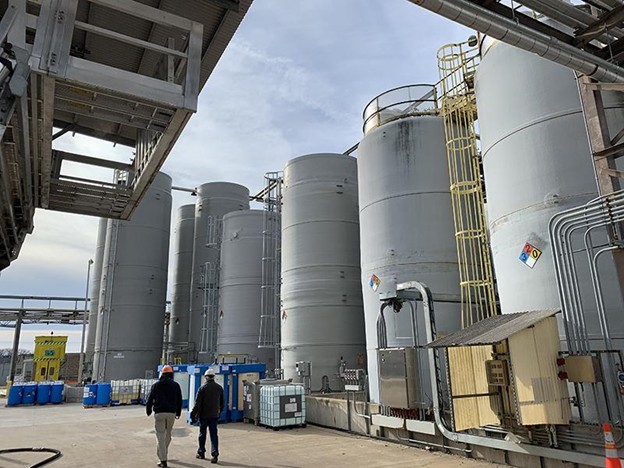
Tank shape follows function. Vertical chemical storage tanks suit fixed installations where floor space is available and gravity feed helps the process. Horizontal tanks suit transport and sites where headroom or footprint is tight. The orientation sets the foundation, the fill and draw arrangement, and the way operators access the vessel.
Bottom Profiles and What They Suit
Belding Tank Technologies Inc. builds each bottom as a unitized, one-piece bottom-to-sidewall construction with no seam at the corner, and a knuckle radius adds hydrostatic resistance. The profile you choose depends on how product needs to move:
- Flat bottom: straightforward bulk storage on a prepared pad.
- Sloped bottom: drains toward a low point, with internal or external slope options.
- Cone bottom: the fullest drainage, which helps with solids removal.
- Dished bottom: a rounded profile that spreads load evenly.
Open and Closed Tops
Closed tanks use dome or flat top heads with a loose cover manhole and grab handle, and they contain vapors and keep contaminants out, which suits volatile or sensitive chemistry. Open tanks have a rim flange turned at 90 degrees and are fitted with covers in one, two, or three pieces, or a lower-cost Type II rim. Open tanks make mixing, sampling, and cleaning easier when the chemistry allows. Tank diameters run from 2 to 30 feet, so the same configuration logic scales from a small dosing tank to a large bulk vessel.
Match your process to the right configuration across the standard tank models.
How Filament Wound and Contact Molded Construction Differ
FRP tanks achieve strength through two construction methods, and Belding Tank Technologies Inc. uses both, often in a single tank. Filament winding lays continuous glass strands around a turning mould under tension, forming a structural layer that runs 60 to 70 percent continuous strand glass. The second method, contact molding or hand lay-up, forms the wall by placing glass reinforcement onto the mould by hand rather than by machine.
Where Each Method Belongs on One Tank
- Filament winding: the cylindrical sidewall, where it adds circumferential strength and precise, repeatable wall thickness, built to ASTM D3299.
- Contact molding: the curved heads, bottoms, and open top rims, worked by hand to ASTM D4097.
- Shared barrier: both methods sit behind the same corrosion barrier, so chemical resistance does not change with a given section’s construction.
Winding tension gives a tall vessel the strength to resist the outward pressure of a full load, which grows with height and is greatest near the bottom. Contact molding serves a different need, since a machine cannot wind a curved head or shaped bottom as cleanly as a skilled laminator can build by hand.
For an operator, the takeaway is simple. Each method does the job it is best suited to: winding gives the sidewall its hoop strength, while hand lay-up shapes the curved heads and bottoms. Belding Tank Technologies Inc. also offers ASME RTP-1 design-by-rules capability for projects that require it. A quote that lists filament-wound sidewalls and contact-molded heads shows each method used where it belongs, and the seam-free bottom-to-sidewall joint removes a common weak point.
If you are choosing between the two for a specific vessel, filament-wound tanks vs contact-molded tanks for chemical storage breaks down how each is built and where each earns its place.
See how each construction method shapes the tank in more detail on the design features page.
What 16 Standard Models and 23 Diameters Offer for Sizing
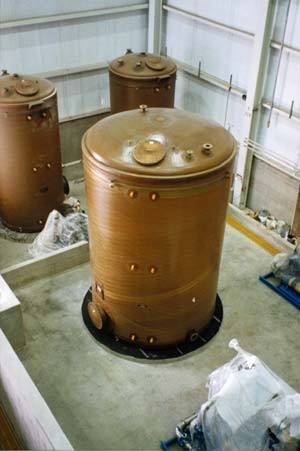
Sizing a chemical tank is easier when the manufacturer works from a defined range. Belding Tank Technologies Inc. offers 16 standard tank models across 23 diameters, so an operator can match capacity to demand without forcing an unusual custom shape for a common duty. A vessel fabricated in the shop reaches up to 60,000 gallons before transport limits take over.
The Standard Diameter Range
Diameters step up in defined sizes rather than arbitrary dimensions, which keeps tooling and lead times predictable. The standard range climbs from 18 inches to 300 inches, including sizes such as 24, 36, 48, 60, 72, 96, 120, 144, 168, and 240 inches.
Reading the Model Code
Each model carries a three-letter code. The first letter gives the top type, the second gives the bottom, and the third gives the orientation:
| Position | Letters and meaning |
| First letter (top) | O = Open top, D = Dome or dished top, F = Flat top |
| Second letter (bottom) | F = Flat, S = Sloped (I internal, X external), D = Dished, K = Cone |
| Third letter (orientation) | V = Vertical, H = Horizontal |
A model coded OSV, for example, reads as an open top, sloped bottom, vertical tank. Working from a coded standard range also keeps sizing conversations precise, since a buyer and an engineer can confirm a configuration in a few letters rather than a paragraph of description. The standard range does not limit customization. By combining diameters, heights, bottoms, tops, resin systems, and fittings, chemical tank manufacturers can produce thousands of distinct configurations from the same proven base, so operators rarely have to choose between a standard tank and the exact tank they need.
Which Containment and Access Features Protect Operations
Corrosive storage carries consequences if a wall is ever breached, so containment deserves early thought. Belding Tank Technologies Inc. builds double wall tanks under the Dual Tek design, which surrounds the primary tank with a second wall and adds early leak detection. A breach then shows up in the space between the walls before product ever reaches the ground, which shortens response time and limits any cleanup. Specifying containment at the design stage costs far less than retrofitting it onto a tank already in service.
Dual Tek Double Wall at a Glance
- Diameters from 18 to 168 inches, with capacities up to 30,000 gallons.
- 100 percent composite construction with early leak detection between the walls.
- Every fitting is placed where the process needs it, not just on top.
- Accepts top and side manways, heating coils, mixers, baffles, ladders, spray balls, siphon drains, and level gauges.
Safe Access for Inspection and Service
Access features protect the people who run the tank. Manways give controlled entry for inspection and maintenance, placed on the top or side depending on the vessel. Ladders, handrails, and platforms give safe elevated access, designed to OSHA guidance. For open tanks, cover options limit exposure to the stored chemical while still allowing access when needed. A double wall guards against an unseen leak, while safe access lets staff verify condition before a small issue becomes a large one.
Concerned about an undetected leak? See how double wall tanks add a second line of containment to your installation.
How Fittings, Manways, and Accessories Support Corrosive Duty
The tank body is only part of a working installation. Fittings connect it to the process, manways open it for service, and accessories keep it running safely. The right choices here prevent the leaks and hazards that a bare vessel would invite.
Flanged and Threaded Fittings
Every flanged connection is drilled to ANSI B16.5 Class 150, matching standard process piping. The range covers the common connection needs on a corrosive tank:
- Siphon nozzles drain close to the bottom, with a standard clearance of a quarter of the pipe diameter or 1 inch minimum.
- Side bottom nozzles, often on sloped tanks, provide the best drainage.
- Pad flanges give a low-profile connection with stainless steel threaded inserts where space is restricted.
- Blind flanges blank off unused ports, and threaded couplings, nipples, and plain pipe cover smaller connections.
- Mushroom vents in 4 and 6 inch sizes and gooseneck vents from 2 to 24 inches, both with removable insect and bird screens, let a closed tank breathe safely.
- Optional vortex breakers, wear pads, and gussets protect the connection under load.
Manway Sizes and Access
Standard manway hardware includes T-316 stainless bolts and an EPDM gasket, with hinged covers and optional quick-release clamps for tool-free entry. Sizing follows the tank:
- Round openings from 20 through 36 inches as standard, with optional sizes to 60 inches and custom rectangular shapes.
- A 20-inch opening serves tanks up to 60 inches across, stepping up to 24 inches on larger vessels, since a ladder needs at least 24 inches to pass.
- A side entry is the better choice on open tanks and on any vessel with 120-inch or taller straight sides, where a top entry leaves too little headroom.
Safety and Operating Accessories
The right accessories are what make a tank safe and easy to run. For access at height, Belding Tank Technologies Inc. supplies OSHA-guided ladders with safety cages and platforms, along with FRP and post-style handrails. For mixing, agitator rails sized to mixer loads work with anti-swirl baffles, set three or four to a tank at a 1-inch standoff and a width of one twelfth of the tank diameter, to keep the liquid steady. For chemistry that must stay warm, insulated heat panels rated 400 or 500 watts at 120 or 240 volts hold the contents above the point where they would thicken or crystallize. And for accurate volume, a laminated calibration strip pairs with a site gauge in clear PVC, reverse float, or magnetic styles.
Because each accessory addresses a specific hazard, it helps to see them in that light: 7 tank accessories that improve safety on chemical storage installations walks through how each one reduces risk on a corrosive installation.
Fit out your tank with the right hardware from the full range of tank accessories.
When Field Assembled Tanks Serve High Capacity Storage
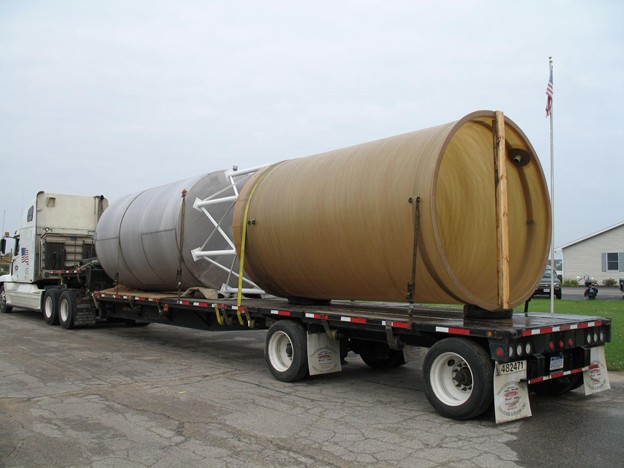
Some storage needs outgrow what a shop can build and ship in one piece, because freight width caps how large a finished cylinder can travel by road. Past that limit, Belding Tank Technologies Inc. turns to field-assembled tanks. Their sidewall sections are filament wound with circumferential joints so they can be joined on site, while the bottom and top heads ship in sections that compress to an oversize load width for transport.
When to Choose Field Assembly
- Required capacity exceeds what ships as one piece, beyond the 60,000-gallon shop-fabricated range.
- Road freight width would otherwise cap the finished cylinder size.
- Access to the tank area on site is limited, so the vessel must arrive in pieces.
- The application needs corrosion-resistant storage of up to 100,000 gallons.
Assembly then happens at the installation site, carried out by a specialized crew from Belding Tank Technologies Inc. or by qualified FRP assemblers working under its supervision. Past projects include field assembled vessels for automotive coating storage and industrial wastewater treatment, both duties that need large volumes of corrosion-resistant storage in one place. The result keeps the corrosion resistance of shop built FRP without the size ceiling that road freight would otherwise impose.
Need more capacity than one delivery can carry? See how field assembled tanks are built on site to reach it.
How Belding Tank Technologies Inc. Reviews Specifications
A sound tank starts with a careful specification review. The more precisely the chemical, strength, temperature, and site conditions are defined, the more accurately the review can match the tank to the job. That upfront clarity is what prevents a mismatch that only shows up years into service.
What the Specification Review Covers
- The resin system, chosen for the medium, its working strength, and its operating heat.
- The corrosion barrier thickness is set for the duty.
- The configuration, fittings, and accessories confirmed against the process.
- Design calculations, with PE stamped calculations available for most states and ASME RTP-1 design by rules on request.
The review is also where trade-offs get settled. A premium vinyl ester build is not always necessary, and a single wall tank is not always enough, so the aim is to match the specification to the duty rather than overbuild it or cut it short. Getting that balance right, fit for the chemical yet sensible on cost, is exactly what buyers should look for in chemical storage tanks manufacturers, and it is the real payoff of a careful review.
That review is where the whole decision comes together. Choosing a chemical storage tank is a sequence of matched steps: the chemical and its conditions, the resin for the pH and temperature, a corrosion barrier set for the duty, and a configuration that fits the process, followed by the construction method, containment, and fittings the application needs. Get them right, and the tank serves reliably for decades. Get them wrong, and the cost shows up as downtime and replacement, which is why the specification stage is where the value is won.
When you are ready to match a tank to your chemical service, Contact Belding Tank to start a specification review and get expert guidance on the right build.
Frequently Asked Questions
How do I know which resin system my chemical needs?
The right system depends on how aggressive the medium is at its working strength and heat. Belding Tank Technologies Inc. offers economy isophthalic, standard vinyl ester lined, and premium all-vinyl ester builds, plus an FDA-approvable polyester for food and brine duty. Give the builder the full duty, and they can point you to the right system.
What is the difference between filament wound and contact molded tanks?
Filament winding is a machine process, governed by ASTM D3299, that gives the sidewall its hoop strength. Contact molding is a hand process, governed by ASTM D4097, used where a machine cannot reach cleanly. A single tank from Belding Tank Technologies Inc. usually combines the two rather than relying on one alone.
How large can a fiberglass chemical tank be?
It depends on the build. A single shop-made vessel tops out near 60,000 gallons because of road transport limits. For larger duties, assembling the tank on site raises the ceiling to roughly 100,000 gallons, with diameters spanning 18 to 300 inches across the 16 standard models.
Do FRP tanks need secondary containment?
Many corrosive applications benefit from it. The Dual Tek double wall design adds a second containment wall and early leak detection while letting the operator place fittings anywhere on the tank. It is available up to 30,000 gallons and is best specified at the design stage rather than added later.
How long do FRP chemical storage tanks last?
Properly installed and correctly matched to their contents, these tanks commonly last more than 25 years. The deciding factor is whether the resin and corrosion barrier suit the stored chemical, which is settled during the specification review rather than after the tank is in place.

