


A fiberglass tank is an engineered laminate, not a plastic container with a lid. The resin system, corrosion barrier, and structural wall each serve a specific duty: the chemical, its concentration, its temperature, and the loads around the tank. Fiberglass tank failures to meet stated service lives almost always trace to the request for quote, where one of these details is omitted.
Imagine a plant engineer shopping for a replacement tank for 12.5% sodium hypochlorite. The purchase order reads “bleach tank, 6,000 gallons.” No one notes the summer heat in the chemical building or the recirculation pump attached to a sidewall nozzle. The tank arrives on time and looks good. Two years later, the interior shows blistering and the nozzle shows cracks at its base. The laminate did its job. The specification did not.
This guide covers what a sound specification contains: how FRP storage tanks are constructed, which resins resist which chemicals, how configuration and loads dictate design, which standards apply, and what Belding Tank Technologies Inc. needs from you to quote a tank fitted to its duty.
Fiberglass Storage Tanks Succeed or Fail at the Specification Stage
A fiberglass tank performs only as well as its specification. Name the chemical, concentration, temperature, and specific gravity precisely, match the resin system to the duty, and install the tank on a flat, fully supporting foundation.
What Are Fiberglass Tanks? Resin, Glass, and Laminate Structure
Fiberglass tanks are pressure vessels formed from glass fiber reinforcement embedded in a thermoset resin matrix. The glass fibers carry the vessel’s load. The resin locks the fibers in place, transfers stress between individual fibers, and acts as a chemical barrier to whatever is being stored in the vessel. Cured thermoset resins don’t liquefy when heated, so the vessel walls maintain their shape over a wide temperature range.
Consider the analogy of a steel-reinforced concrete column. The steel rebar is tensioned and compressed, while the concrete protects it and prevents oxidation. The same principle applies to fiberglass tank walls: glass fibers provide tensile strength, and the resin protects the glass from the environment. Expose raw glass fiber to many chemicals, and it will quickly degrade. Every fiberglass tank design feature centers on protecting the integrity of the glass fibers.
FRP, GRP and Fiberglass: Clearing Up the Terminology
Four names describe one material family:
- FRP (fiberglass reinforced plastic): the standard term in North American specifications.
- Fiberglass is the everyday shorthand buyers, operators, and maintenance crews use on the plant floor.
- GRP, short for glass-reinforced plastic, dominates in the UK, Europe, and the Middle East.
- RTP appears mainly in ASME documents, where the letters stand for reinforced thermoset plastic.
All four point to the same construction. Use whichever term your organization’s specifications use, and name the resin every time, since the resin defines chemical performance.
How the Wall Is Built Up
Belding Tank Technologies Inc. describes the tank wall in four layers: the Inner Surface, the Interior Layer, the Structural Layer, and the Outside Surface. Each layer has a separate job. Confusing these layers is one of the most common causes of weak specifications.
The Corrosion Barrier: Inner Surface and Interior Layer
The corrosion barrier consists of the Inner Surface and Interior Layer. The Inner Surface is the layer that is in direct contact with the stored product. This resin-rich layer is reinforced with a thin veil. The Interior Layer lies behind this veil, adding thickness with chopped strand glass in resin to increase resistance to penetration by the stored chemical.
Belding Tank Technologies Inc. specifies a glass content of 27% +/- 5% by weight for the corrosion barrier. This low percentage is intentional because the resin content provides resistance to a given chemical. The low glass percentage means fewer pathways for the chemical to penetrate, increasing the barrier’s resistance. Tanks are also molded on a male mold to give a smooth, resin-rich inner surface for improved corrosion resistance. Learn why corrosion barrier design extends chemical tank service life.
The Structural Layer
The Structural layer carries hydrostatic pressure, wind, seismic forces, and the weight of attached equipment. It has a higher glass content because strength, not chemical resistance, governs it. On a vertical tank, wall thickness increases toward the bottom because hydrostatic pressure increases.
The Outside Surface and UV Protection
The outside surface protects the vessel from external conditions such as weather, sunlight, and general handling. UV light degrades the resin, which, if left unprotected, exposes the laminate’s glass fibers to the outside, commonly called fiber blooming.
Specify outdoor tanks with either UV-inhibited resin or a pigmented exterior coat. Propose exterior protection at the time of quotation, as adding it to an installed vessel is much more expensive and disruptive.
Manufacturing Methods for FRP Storage Tanks
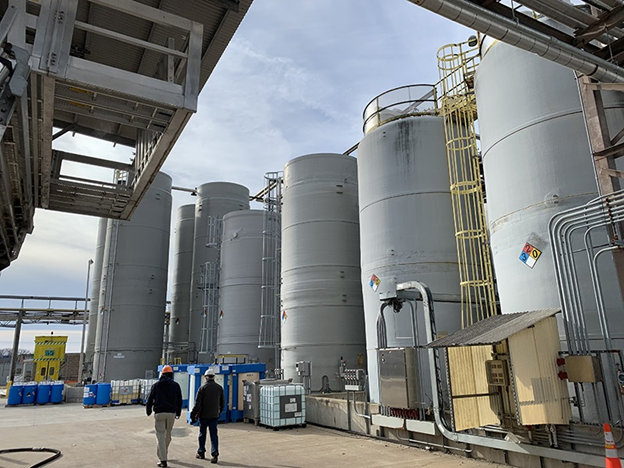
Belding Tank Technologies Inc. manufactures both contact-molded and custom filament-wound tanks. The method shapes wall structure, size range, and consistency.
Filament Winding
Filament winding pulls continuous glass strands through a resin bath and wraps the impregnated fibers around a rotating mandrel at a prescribed angle. The machine orients the glass in the direction of the loads, which are primarily circumferential due to hydrostatic hoop stress. The result is a strong, uniform cross-section shell ideally suited to cylindrical pressure vessels of moderate to large diameters.
Contact Molding and Hand Layup
Contact molding is a hand layup process in which the fabricator layers chopped strand mat and woven roving on a mold, then works out air pockets before the resin cures. The process is far more versatile than filament winding because it can form shapes a mandrel can’t. Contact molding creates features such as cone bottoms, dished heads, sumps, flanges, and the junction between the shell and the bottom head.
Where Each Method Fits
Most pressure vessels use a combination of the two methods. You can attach a filament-wound shell to a contact-molded head or bottom. Belding’s product literature specifies 72 inches as the dividing diameter: below 72 inches, and as the diameter tends toward larger sizes, contact molding is used. Neither method is inherently better than the other. The question should be which method is better for various parts in a given pressure vessel application, and the answer is usually apparent.
Resin Systems and What They Resist
The resin decides whether a tank survives its chemical. Choose the wrong resin, and no amount of wall thickness will save the tank.
Belding Tank Technologies Inc. offers three resin systems:
| Resin System | Inner Surface and Interior Layer | Structural Layer and Outside Surface |
| Economy | Isophthalic polyester | Isophthalic polyester |
| Standard | Premium grade vinyl ester | Isophthalic polyester |
| Premium | Premium grade vinyl ester | Premium grade vinyl ester |
Isophthalic polyester offers economical resistance to water, many diluted acids, and mild salt solutions. Vinyl ester provides better, more extensive resistance to various acids, caustics, and oxidizing agents and can tolerate higher temperatures. The Standard system uses vinyl ester to meet chemical contact requirements, with isophthalic polyester in areas subject to greater mechanical stresses. For most plant duties, using both polyester and vinyl ester laminates strikes the right balance.
Tougher duties need more specialized resins, such as Novolac vinyl esters for higher-temperature applications and some solvents, and bisphenol A fumarate polyesters for certain caustic and bleach services. Other chemical-resistant laminates incorporate a thermoplastic liner to meet the demands of more exotic chemicals not available in thermoset resin systems.
Chemical resistance charts are a guide only. The resistance data quoted applies to single chemicals at specific concentrations and temperatures. In a process stream, impurities, concentration fluctuations, and temperature variations can affect resistance. Provide the complete chemical analysis and have your fabricator evaluate it, who can recommend the most suitable resin system.
Custom Fiberglass Tanks: Vertical, Horizontal and Field Assembled Configurations
Belding Tank Technologies Inc. builds vertical and horizontal tanks in flat bottom, cone bottom, dish bottom, slope bottom, and double-wall configurations. Choose the bottom based on how your product drains, settles, and gets cleaned.
- Flat bottom: the workhorse of bulk storage, resting fully on a level pad.
- Cone bottom tanks drain completely through a low outlet, which suits slurries, settling solids, and batch processes. They stand on legs or a support structure.
- Dish bottom designs use a shallow curved base for better drainage than a flat bottom.
- Need drainage without the height of a cone? A slope bottom tilts the floor toward the outlet.
- Horizontal tanks fit under low roofs or inside buildings with limited height and rest on saddles.
- Double wall tanks place a primary vessel inside a secondary shell.
Custom fiberglass tanks start from these configurations and add the details your process needs. Brine operations and water treatment plants ordering the same diameter often receive two different tanks. Our guide on how tank shapes impact flow and process efficiency covers these tradeoffs in more depth.
Field Assembled Tanks
Some storage needs can outgrow the highway. A shop-built tank travels by truck, which can only carry so much. Field-assembled tanks avoid the problem. Belding Tank Technologies Inc. fabricates tanks in sections with filament-wound sidewalls and assembles them on site to reach storage capacities of up to 100,000 gallons.
But it can also help in other ways. Imagine a wastewater plant that needs to fit storage inside an existing building, but doors, columns, and crane limits block the way. Sections can snake through openings an assembled tank couldn’t fit through. The tradeoff is that field-assembled tanks require a foundation, a work area, and a weather window, so you must build those into the schedule early.
Dual Laminate and Double Wall Construction
These two terms are similar, but they solve different problems.
Dual laminate construction uses a thermoplastic liner, such as PVC, CPVC, polypropylene, or PVDF, bonded to an FRP structural shell. The liner handles chemical service that thermoset resins can’t withstand (hydrofluoric acid is one example), and the FRP shell carries the load. Belding Tank Technologies Inc. has issued guidelines for evaluating dual-laminate tanks for hydrofluoric acid storage.
Double-wall construction uses two complete tanks, one inside the other, with a space between them. In a leak, the inner tank contains it, while the space between the tanks allows leak detection. Facilities storing hazardous chemicals often use double-wall fiberglass storage tanks to meet secondary containment requirements, subject to local regulations.
Use a dual laminate to deal with a chemistry issue. For leaks, use double-wall construction; some require both.
Sizing: Capacity, Diameter, Height and Specific Gravity
Capacity starts the conversation but rarely finishes it. Four numbers shape the design.
Working capacity is the volume you plan to use. Total capacity sits above it, leaving freeboard for venting, foaming, and level instruments. Diameter sets the footprint, and height follows from capacity and diameter together.
Specific gravity is the number buyers forget most often, and it has the biggest structural impact. Store 50% sodium hydroxide, with a specific gravity near 1.5, in a tank designed for water, and the lower shell sees roughly 50% more hydrostatic pressure than its design assumed. Always state specific gravity, even for products you consider routine.
Design Loads: Hydrostatic, Wind, Seismic, Vacuum and Live Loads
Hydrostatic pressure is the baseline load. A full tank pushes outward hardest at the bottom of the shell. Beyond the liquid itself, a tank faces several other forces:
- Wind, which pushes on tall tanks and tries to slide or tip them. An empty tank is the worst case.
- Seismic loads in active regions slosh the contents and drive overturning forces into the anchors.
- Vacuum from rapid draining or a blocked vent. FRP walls resist internal pressure well and external pressure poorly.
- Snow, people, and roof platforms.
- Agitators, which add torque, vibration, and bending to the roof or sidewall mount.
ASTM tank specifications flag earthquakes, wind, and agitation as conditions needing special design consideration. Give your fabricator real site data instead of assuming a standard tank covers your location.
Nozzles, Manways, Fittings and Nozzle Load Limits
Nozzles are where good tanks get hurt. Fiberglass nozzles resist liquid pressure well. Piping hung from it applies bending and shear that the laminate was never sized to carry.
The fix costs little. Support the pipework independently, install flexible connectors near the tank, and send the fabricator a nozzle schedule with sizes, positions, and expected loads.
Belding Tank Technologies Inc. supplies manways and fittings as part of its product range. Top manways serve inspection and venting. Side manways provide access for cleaning and repair, and their position affects safety during confined-space entry.
Accessories: Covers, Ladders, Vents and Heat Maintenance
Accessories turn a vessel into a working part of the plant. Belding Tank Technologies Inc. offers flat or domed covers, manways, fittings, ladders, and heat maintenance systems. Plan these items at the start:
- Level gauges and instrument nozzles.
- Size vents for worst-case fill and drain rates, and screen them against insects and birds.
- Heat maintenance for cold-sensitive products. Diesel Exhaust Fluid freezes near 12°F, and many process chemicals thicken or crystallize through a Midwest winter.
- A ladder with platforms and handrails for operators who need regular roof access.
A domed cover sheds snow and rain. A flat cover simplifies mounting equipment. Choose based on what sits on top of the tank.
Applicable Standards and What They Govern
Standards give buyers and fabricators a shared language. Knowing which one applies keeps you from paying for requirements your duty doesn’t need or skipping ones it does.
| Standard | What It Governs |
| ASTM D3299 | Glass fiber-reinforced thermoset resin corrosion-resistant tanks. The 2026 revision brings filament-wound and contact-molded tanks under one specification. |
| ASTM D4097 | Contact-molded corrosion-resistant tanks. ASTM has balloted its withdrawal, since its content now sits inside D3299. |
| ASME RTP-1 | Reinforced thermoset plastic corrosion-resistant vessels up to 15 psig internal pressure, with fabricator certification and code stamping. |
| ASTM C582 | Contact molded laminates for corrosion-resistant equipment, including corrosion barrier construction. |
| NSF/ANSI/CAN 61 | Health effects of materials in contact with drinking water. |
Most atmospheric fiberglass storage tanks are spec’d to ASTM tank standards. Adding third-party inspection and heavier documentation in ASME RTP-1 makes sense for pressure or vacuum service, highly hazardous contents, or an owner who requires a code stamp.
For a simple process water tank, it adds cost without protection. Know which standard your duty requires and ask the vendor to show you what standard the quoted tank follows.
Temperature, Thermal Expansion and Service Limits
Temperature and concentration move together. A resin that performs well with a chemical at 100°F may fail with the same chemical at 160°F. ASTM tank specifications require special design considerations above 180°F.
List every temperature event, not only the normal operating point. Hot fills, steam cleaning, heat tracing faults, and exothermic reactions inside the tank all count. FRP also expands more than steel, so connected piping needs room to move.
Foundation, Anchoring and Installation Requirements
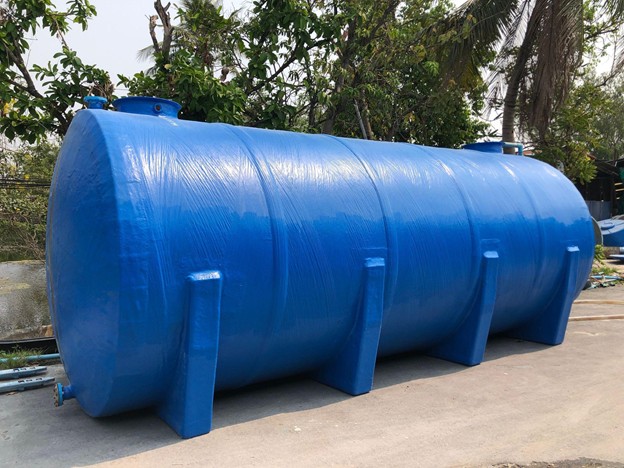
A correctly built tank still fails on a bad pad. Flat-bottom fiberglass tanks need full, uniform support: a smooth, level concrete surface, free of stones, ridges, and voids. A single high spot under the bottom concentrates stress in the laminate and starts cracks.
Anchors resist wind, seismic forces, and uplift on an empty tank. During delivery, lift only at the designated lifting lugs, never drag the tank, and keep chains off the laminate. Belding Tank Technologies Inc. publishes instruction manuals on its website. Read the installation guidance before the truck arrives, not after.
Inspection, Maintenance and Service Life
FRP tends to fail slowly and visibly, which gives owners warning, provided someone looks. A simple routine catches most problems early:
- Walk the exterior on a fixed schedule. Look for weeping, discoloration, crazing on the roof, and cracks around nozzle bases.
- On the same walk, check anchor bolts, vents, and flexible connectors.
- Inspect the interior at intervals matched to the chemical’s severity, since blisters, softening, exposed fibers, and color change in the corrosion barrier all signal chemical attack.
- Photograph and date every finding. A trend tells a story a snapshot can’t.
Service life depends on the resin’s compatibility with the service environment, temperature, and adherence to installation and inspection practices. Servicing a tank when you discover a leak is likely to extend its service life more than deferring it until catastrophic failure.
Repair and Field Service
Technicians generally repair damaged FRP tanks in place by grinding out the damaged ply laminates and replacing them with new ply laminates for the corrosion barrier and structural layers, then curing. A properly performed field repair enables return to service, avoiding inventory loss and downtime associated with complete removal, replacement, and extended cure time.
Belding Tank Technologies Inc. offers professional field service to inspect and repair FRP tanks, with experienced personnel available throughout the tank’s life. Contact Belding Tank Technologies Inc. with details on the tank’s age, contents, resin system (if known), and clear photos of the damaged area. This information will help us develop a repair recommendation.
FRP Compared With Steel, Stainless, Polyethylene and Lined Steel
Every material earns its place somewhere. The real question is which one fits your duty. For smaller tanks, see our comparison of fiberglass vs. polyethylene tanks for chemical storage.
| Material | Where It Performs | Where It Falls Short |
| FRP | Acids, caustics, and hypochlorite without an internal coating. Custom sizes and configurations. Repairable in place. | Depends on correct resin selection. Sensitive to point loads and piping loads. Temperature ceiling set by the resin. |
| Carbon steel | High temperatures, fuels and many solvents. | Rusts in corrosive service without a coating or lining. |
| Stainless steel | Hygienic service, high temperatures, many process streams. | Chlorides and hydrochloric acid attack the metal. |
| Polyethylene | Small, simple duties at modest temperatures. | Capacity ceilings, lower temperature limits and limited repair options. |
| Lined steel | Steel strength with a chemical barrier. | A lining failure exposes the steel behind it, and relining means downtime. |
Take a tank for 35% hydrochloric acid. Stainless steel suffers rapid attack. Carbon steel needs a rubber lining with its own inspection burden. FRP with a suitable corrosion barrier holds the acid directly. Switch the duty to a hot solvent, though, and the answer flips toward steel. Honest comparisons depend on the chemical, not the brochure.
Applications by Stored Product
Belding Tank Technologies Inc. builds application-specific fiberglass storage tanks for a wide range of products:
- Hydrochloric, sulfuric, hydrofluoric, fluosilicic, and hydrofluosilicic acids.
- Caustics, including sodium hydroxide and potassium hydroxide.
- Sodium hypochlorite storage tanks, for one of the most demanding everyday chemicals for any tank.
- Ferrics, alums, and polymers for water and wastewater treatment.
- Diesel Exhaust Fluid.
- Food and beverage products. Belding Tank Technologies Inc. has built thousands of fiberglass tanks for brining pickles and cherries.
Fiberglass Water Tanks
Water seems easy, but it isn’t. Potable service specifies material requirements for drinking water. Residual chlorine attacks some resins.
Light penetration through a thin, unpigmented wall promotes algae growth. Process water, fire reserve, and irrigation storage each have different requirements, so define the use and treatment in your request. For more clarity, learn why fiberglass tanks suit commercial fire protection systems.
Diesel Exhaust Fluid Storage
DEF is a urea solution sensitive to contamination. Industry guidance keeps DEF away from carbon steel, since metal contamination harms the emission systems DEF serves.
FRP keeps metals out of the equation entirely. Maintain heat in winter when temperatures threaten to drop below the fluid’s freezing point. See our diesel exhaust fluid tanks for heated, contamination-free storage.
Industries We Serve
Belding Tank Technologies Inc. serves chemical processing, food and beverage, automotive, iron and metal, wastewater treatment, pulp and paper, pharmaceutical, agriculture and fishery operations. DEF storage shows how one chemical brings different demands across three sectors:
- Agriculture: farms keep DEF on site for tractors, combines and sprayers. A dry tank during harvest costs days, not hours.
- Transportation and shipping fleets store DEF in their yards to refill trucks between routes, so a reliable on-site supply keeps vehicles on schedule.
- Industrial sites hold DEF for heavy equipment and diesel backup generators.
For backup power, the stakes are high. A generator needs clean DEF on the day the grid fails, not the day after. Contaminated or frozen fluid turns standby power into no power.
What to Include in a Fiberglass Tank Quote Request
Manufacturers quote what you tell them. An incomplete request ends one of two ways: a padded price covering the unknowns, or a tank unsuited to the duty. Both cost you, and the second costs more.
Belding Tank Technologies Inc. product literature asks for the working capacity, tank model, desired diameter, the material stored with its concentrations and specific gravity, and agitator details where relevant. Round out the request with the rest of this list:
- Chemical name, concentration range and known impurities
- Normal and maximum temperatures, including cleaning cycles
- Specific gravity
- Working capacity and total capacity
- Footprint and height limits
- Indoor or outdoor location, with wind, seismic and snow data
- Nozzle schedule with sizes, positions and flange ratings
- Covers, manways, ladders and heat maintenance needs
- Pressure, vacuum and fill or drain rates
- Required standards, testing and documentation
- Delivery access and rigging constraints
A few minutes spent on this list saves rounds of revisions later.
Why Specifiers Work With Belding Tank Technologies Inc.
Choosing among fiberglass tank manufacturers comes down to fit: the right methods, the right resin options, and a team willing to ask hard questions about your duty.
Belding Tank Technologies Inc. has built fiberglass tanks in Belding, Michigan, since 1976, when founder Daniel W. Blunt Sr. started the company with six other employees. A new manufacturing facility followed in 1994. Today, more than 60 people work across nearly 40,000 square feet of manufacturing space on more than 10 acres.
What specifiers get in practice:
- Both contact-molded and custom filament-wound construction under one roof.
- Three defined resin systems, Economy, Standard, and Premium, so the corrosion barrier matches the chemistry.
- Field-assembled tanks up to 100,000 gallons for sites where shop-built tanks will not fit.
- Field services for FRP tanks across the life of the system.
The company motto sums up the approach: “Quality is our Standard, Customer Service is our Specialty.”
Specify Your Next Fiberglass Storage Tank Before Small Gaps Become Costly Failures
Every gap in a tank specification becomes a risk someone pays for later. A blistered corrosion barrier. A cracked nozzle. An unplanned shutdown while you wait for a replacement to ship. Closing those gaps costs far less before fabrication than after.
If a tank purchase sits on your schedule, start with the quote checklist above, then contact Belding Tank Technologies Inc. at 800-253-4252 or 616-794-1130, or email sales@beldingtank.com. Bring your chemistry, your site data, and your questions, and get a tank built for its real duty.
Frequently Asked Questions
Which resin system does my chemical need?
The answer depends on chemical, concentration, and temperature. Share all three, plus impurities, so your fabricator matches the Economy, Standard, or Premium system to the duty.
What is the largest tank Belding Tank Technologies Inc. builds?
Field-assembled tanks reach storage capacities up to 100,000 gallons, built from filament-wound sidewall sections and assembled on site.
Do fiberglass tanks need special foundations?
Flat-bottom tanks need a smooth, level pad for full support. Cone-bottom tanks rest on legs or support structures designed to carry the load.
Does Belding Tank Technologies Inc. service existing FRP tanks?
Yes. Belding Tank Technologies Inc. offers professional field services for FRP tanks, with on-site support throughout a storage system's life.


