


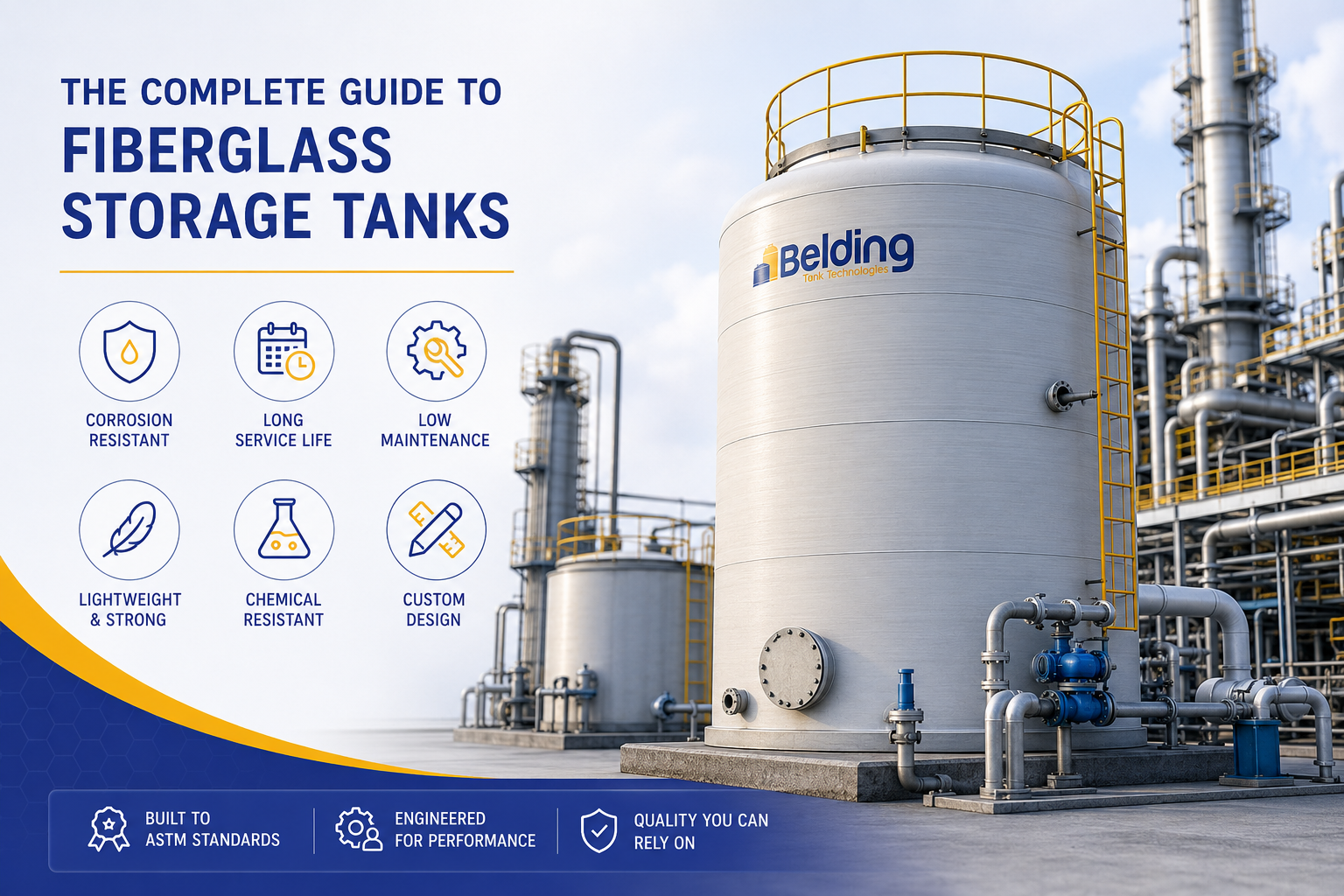
Industrial storage systems are not just about storing liquids. They are essential for the safe storage of valuable materials, product quality control, worker safety, and uninterrupted operations. The choice of storage solution can significantly affect the business’s efficiency, maintenance costs, regulatory compliance, and return on investment, regardless of whether it handles chemicals, process water, wastewater, pharmaceutical, or food-grade ingredients.
Before Getting Started: Choosing the right fiberglass storage tank requires more than selecting the correct capacity. Engineering quality, material compatibility, and manufacturing standards all influence long-term performance. Belding Tank Technologies Inc. designs tanks to ASTM D3299 and ASTM D4097 standards, supported by CAD engineering, structural calculations, comprehensive quality assurance, and inspection processes. Custom options such as nozzles, ladders, platforms, and both filament-wound and field-assembled tanks allow each storage solution to match specific industrial requirements.
Key Takeaways: Fiberglass storage tanks provide corrosion resistance, durability, and design flexibility for industries such as chemical processing, wastewater treatment, food production, and agriculture. Selecting the right tank requires evaluating material compatibility, engineering quality, and customization options. Belding Tank Technologies Inc. supports these requirements through ASTM-compliant manufacturing, engineering expertise, rigorous quality assurance, and custom fabrication, helping facilities achieve reliable, long-term storage performance.
For decades, the industrial storage market was dominated by steel and concrete. These materials are still used in certain applications, but the business’s long-term requirements have led to the adoption of more durable, corrosion-resistant materials. Nowadays, fiberglass storage tanks offer excellent durability and low maintenance requirements, making them one of the most cost-effective options for water storage.
Today’s engineers, plant managers, and procurement teams are increasingly considering storage systems by focusing on the total lifecycle value rather than just the up-front cost. When properly designed, an FRP tank can deliver decades of service with minimal maintenance, making it a wise investment for facilities that value operational efficiency and asset performance.
This guide covers the manufacture of fiberglass storage tanks, their benefits, typical industrial applications, comparisons with other materials, maintenance tips, and when to choose fiberglass storage tanks. We will also discuss how collaborating with a trusted fiberglass tank manufacturer and an FRP tank manufacturer can improve your storage system’s performance, reliability, and longevity—and, of course, cost.
What Are Fiberglass Storage Tanks?
Fiberglass storage tanks are engineered containment systems designed to safely contain liquids, chemicals, wastewater, process fluids, and other industrial materials under a wide range of operating conditions. These tanks are made from fiberglass-reinforced plastic (FRP), a material consisting of layers of glass fiber-reinforced resin. The material is light, strong, and highly corrosion-resistant.
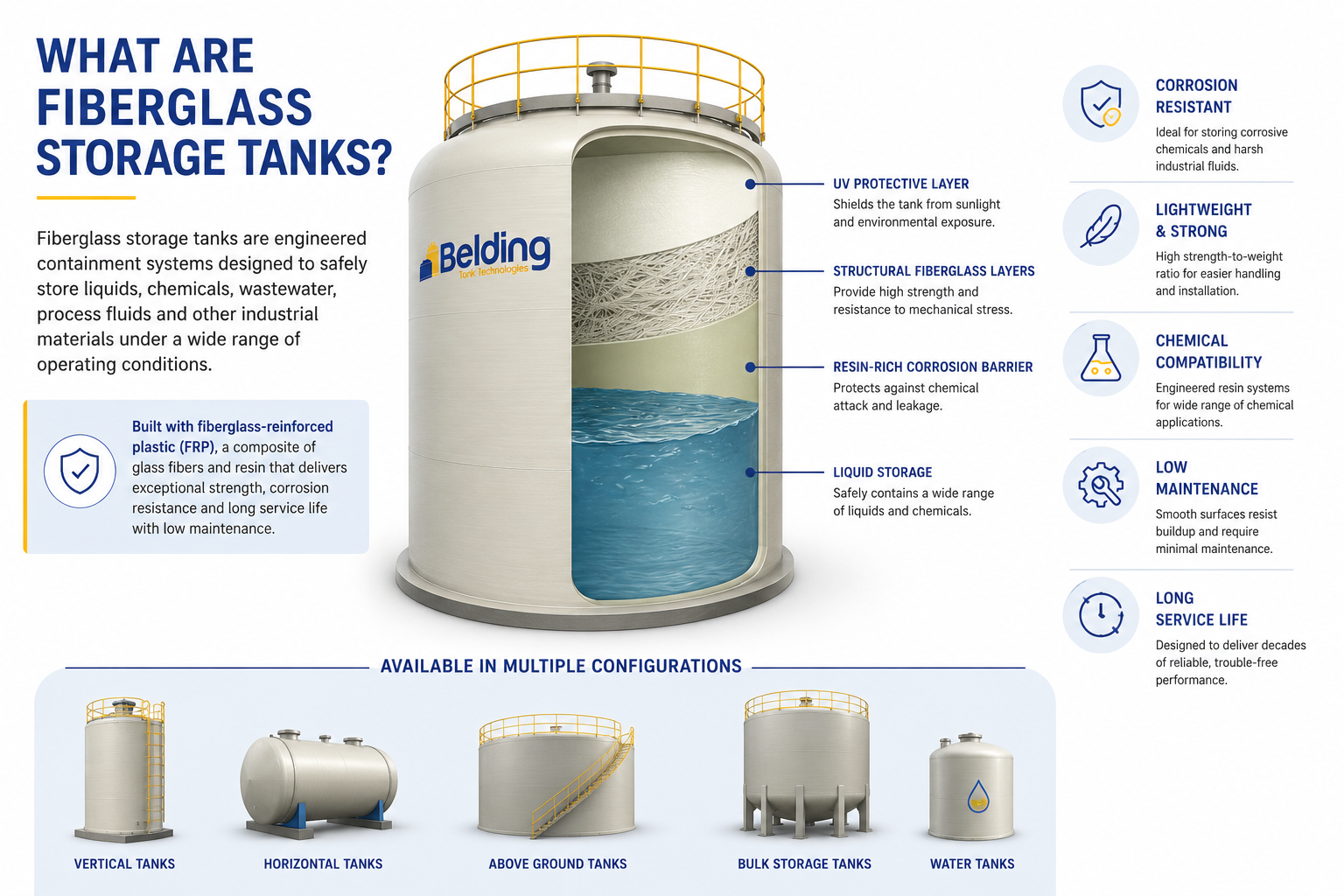
The terms “fiberglass tanks” and “FRP tanks” are often used interchangeably because both refer to storage systems manufactured from fiberglass-reinforced plastic. The glass fibers provide mechanical strength to resist the forces acting on the tank, and the resin matrix holds the fibers in place and protects the tank from environmental degradation, chemicals, and UV exposure. This construction provides a lightweight storage solution with excellent durability and reduced maintenance requirements.
One of the most distinguishing benefits of fiberglass is its flexibility. Vertical and horizontal tanks, as well as custom bulk storage tanks, are available from manufacturers in a variety of capacities. This adaptability allows facilities to choose the type of storage that best fits their current space constraints, operational needs, and long-term growth plans, without sacrificing performance.
In addition to selecting the FRP tank, it is important to choose the right resin system for the specific application. Industries have different needs for chemical resistance, temperature resistance, and structural performance. For instance, fiberglass water tanks for potable or process water would have different resin formulations than tanks for highly corrosive industrial chemicals.
The versatility of fiberglass storage tanks has enabled their use in a variety of applications.
In the following section, we’ll explore the production process for these advanced storage systems and discuss how it is crucial to their long-term strength, reliability, and performance.
How Fiberglass Storage Tanks Are Manufactured
The performance of fiberglass storage tanks starts before they are even installed in an industrial facility. Each tank is designed and built for a particular purpose and can safely withstand the mechanical, chemical, and environmental stresses of its intended application.
FRP tanks are produced through a composite construction process, unlike traditional storage systems that use a single material. This includes the use of high-strength glass fibers and special resin systems, which result in an extremely strong and lightweight
construction. The end product is a storage unit that is not only corrosion- and chemical-resistant but also won’t be ruined by moisture or the elements and will last for many years.
Manufacturing Methods
Experienced fiberglass tank manufacturers employ cutting-edge manufacturing methods to guarantee durability, quality, and consistency.
Some of the most common production methods include:
- Filament winding is a process in which continuous glass fibers are wound around a rotating mold to form very strong structures.
- Hand lay-up is used for more customization and is sometimes used for specialized tank designs.
- Spray-up construction: Applicable in some cases where the shape is complicated.
The manufacturing process is selected based on the tank’s size, application, operating pressure, and performance requirements.
An engineering approach to long-term performance
Very few industrial storage systems have the same conditions. A potable water storage tank cannot be the same size or shape as a tank used to hold highly corrosive chemicals.
For this reason, FRP tank manufacturers engineer every storage system around several important factors, including:
- Chemical compatibility
- Storage capacity
- Operating temperature
- Installation location
- Structural loading
- Environmental exposure
- Applicable industry standards
When designing the tank around these variables, the need for maintenance over the tank’s lifetime is reduced, maximizing service life.
Quality Control and Testing
All tanks should be fully inspected for quality before leaving the manufacturing plant. The manufacturers can do one or more of the following:
- Dimensional inspections
- Wall thickness verification
- Resin integrity testing
- Visual surface inspections
- Leak testing
- Structural evaluations
Benefits of Fiberglass Storage Tanks
Industrial facilities are places where equipment reliability is directly related to productivity. Unexpected downtime can result in higher maintenance expenses, production delays, and operational risks. This is one of the main reasons why fiberglass storage tanks have become the preferred storage solution in so many industries.
Outstanding Corrosion Resistance
One of the most significant advantages of FRP tanks is their natural corrosion resistance.
Long Service Life
When properly engineered and maintained, fiberglass tanks can provide reliable service for decades.
Lightweight Construction
Fiberglass has a much higher strength-to-weight ratio than steel or concrete.
Lower Maintenance Requirements
Maintenance expenses can significantly impact the overall cost of operating industrial equipment.
The resistance of fiberglass to rust, scaling, and chemical attack generally reduces maintenance needs compared with traditional storage materials. This enables maintenance teams to concentrate on preventive inspections rather than frequent repairs.
Excellent Chemical Compatibility
A whole range of industries store different types of chemicals and have different handling requirements.
The correct resin system can make fiberglass storage tanks suitable for storing a wide variety of corrosive liquids with long-term structural integrity.
Flexible Design Options
Each industrial plant has different operational needs.
Different monitoring systems, ladders, access hatches, nozzles, and bulk storage tank capacities and insulation can be added to an existing setup or tailor-made to suit the business’s needs.
Cost-Effective Over the Long Term
Initial investment will vary depending on size and customization. Still, because of lower maintenance, downtime, and longer service life, fiberglass may prove the more economical choice over the life of the equipment.
Types of Fiberglass Storage Tanks
Every industrial application has different storage needs. The dimensions, slope, volume, and shape of a tank are determined by the type of material being stored, the available installation space, and operational goals.
There are many configurations available from experienced fiberglass tank manufacturers to meet these requirements.
Vertical Fiberglass Storage Tanks
Vertical tanks are among the most popular storage options for facilities with limited floor space. Their vertical structure optimizes storage space and reduces installation space.
Horizontal Fiberglass Tanks
Horizontal tanks are often chosen when height clearance is limited or when other installation or transportation needs dictate a lower-profile tank.
Above-Ground Storage Tanks
For many industrial facilities, above-ground fiberglass storage tanks are a viable option for ease of inspection, maintenance, and system changes.
Bulk storage tanks are designed to store large quantities of liquids in industries such as chemical processing, agriculture, wastewater treatment, and manufacturing. They are ideal for operations that require long-term storage and reliability, and offer good capacity and customization options.
Fiberglass water tanks are used to store potable water, process water, fire protection reserves, and other water-based applications.
The following section will examine how various industries use fiberglass storage tanks to address specific challenges.
Discuss your storage requirements with Belding Tank Technologies Inc. to identify the right tank configuration for your application.
Industrial Applications of Fiberglass Storage Tanks
One of the biggest reasons behind the growing adoption of fiberglass storage tanks is their versatility. From highly corrosive chemicals to process water, from food-grade ingredients to pharmaceuticals, today’s industries demand storage solutions that can handle it all.
FRP tanks are a reliable solution across various industries due to their corrosion resistance, strength, and design versatility. From operational efficiency to regulatory compliance, fiberglass brings tangible benefits that go beyond the cost and into the long haul.
Now let’s look at some of the industries where fiberglass storage systems continue to prove their worth.
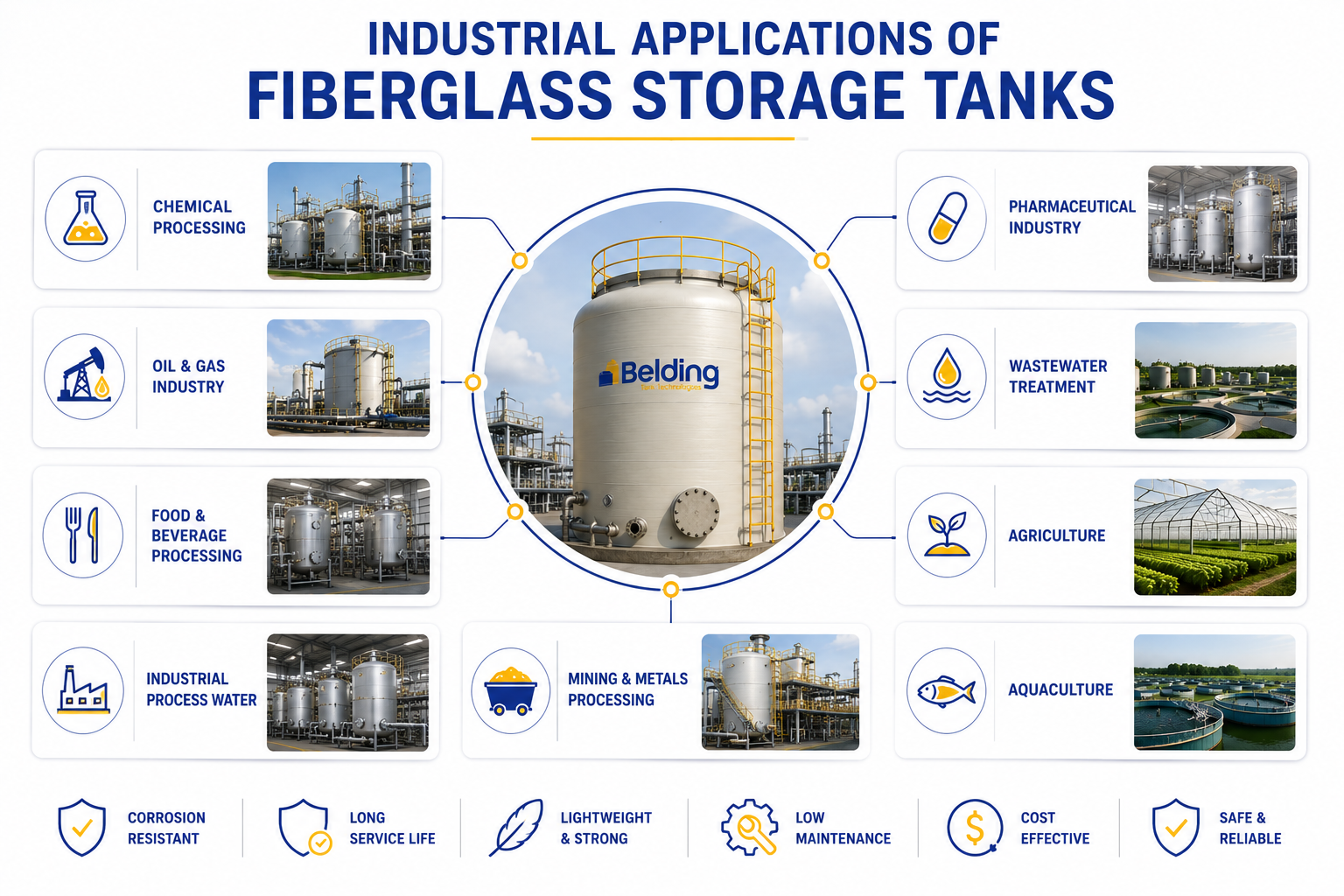
Chemical Processing
In most chemical factories, corrosion can lead to reduced storage equipment life, higher maintenance expenses, safety risks, and production delays.
That’s where fiberglass storage tanks come in handy. Choosing the right resin system in the engineering process enables tanks to withstand highly corrosive environments and retain structural integrity over many years of continuous use.
FRP tanks prevent rust, chemical attack, and moisture, which reduces the amount of maintenance needed and the risk of contamination. The lightweight construction also makes them easier to install than heavier options.
Pharmaceutical Manufacturing
The pharmaceutical industry is particularly strict about cleanliness, product integrity, and regulatory compliance.
Fiberglass tanks are an ideal solution for these applications, as they do not corrode, are low-maintenance, and can be designed for specific chemical compatibility.
Pharmaceutical ingredient manufacturing facilities choose fiberglass storage tanks because:
- Purified water storage
- Chemical feed systems
- Process water
- Waste collection
- Raw material storage
For more information about this application, please read our blog: Why Fiberglass Tanks Are the Unsung Heroes in Pharmaceutical Manufacturing.
Oil & Gas Industry
The oil and gas industry’s storage equipment faces some of the most challenging conditions. When conventional materials are used, exposure to moisture, chemicals, hydrocarbons, saltwater, and varying temperatures can lead to higher maintenance costs and increased corrosion.
This is why many operators are still investing in FRP tanks for above-ground storage, secondary containment systems, process applications, and wastewater handling.
The major benefits are:
- Excellent corrosion resistance
- Long service life
- Reduced maintenance
- Lower lifecycle costs
- Lightweight installation
- High structural reliability
These benefits can help maximize efficiency and minimize downtime in the event of an unexpected issue.
To learn more about industry-specific advantages, read our blog: Top Reasons Why Fiberglass Tanks Are Preferred for Effective Oil & Gas.
Water and Wastewater Treatment
Reliable storage systems are essential for potable water, wastewater, treatment chemicals, sludge, and process liquids at municipal and industrial water treatment facilities.
Fiberglass water tanks offer long-lasting durability and are resistant to rusting, scaling, and chemical degradation. Their ability to withstand demanding operating conditions with minimal maintenance makes them a practical solution for treatment plants, manufacturing facilities, and infrastructure projects.
The selection of materials is particularly significant when assessing sewage storage systems.
Check out our blog to learn more about the differences between the options: Fiberglass Sewage Tank vs. Concrete Sewage Tank: Which One Should You Choose?
Food and Beverage Processing
Food manufacturers need storage solutions that comply with hygiene standards, maintain product quality, and enhance operational efficiency during the manufacturing process.
Due to their corrosion resistance and ability to be tailored to various operational needs, fiberglass storage tanks are becoming increasingly popular in food processing facilities. They are durable and low maintenance, minimizing disruption and maintaining smooth daily operations.
Agriculture
Reliable storage is crucial for agricultural operations, including irrigation, fertilizer management, livestock operations, and water conservation. When tanks are used outdoors, they must endure constant exposure to heat, humidity, and changing weather conditions.
Bulk storage tanks made of fiberglass offer a practical solution, as they are both structurally strong and highly resistant to environmental conditions.
Typical agricultural applications include:
- Fertilizer storage
- Irrigation water
- Liquid feed supplements
- Agricultural chemicals
- Rainwater harvesting
They can last a long time, reducing the need for maintenance and ensuring reliable performance during the growing season.
Aquaculture and Fish Farming
Storage equipment has specific requirements for aquaculture systems. Tanks need to maintain water quality and should not be subject to corrosion from moisture, minerals, or cleaning regimes.
For these reasons, many fish farming and aquaculture operations have chosen fiberglass tanks.
Common applications include:
- Fish holding tanks
- Water treatment systems
- Hatcheries
- Recirculating aquaculture systems
- Aquatic research facilities
For more details about this application, check out our blog: Why Fiberglass Tank Is an Ideal Material for Storing Fish.
Why Fiberglass Continues to Gain Industry-Wide Acceptance
In every sector, business leaders seek storage solutions that minimize maintenance, maximize reliability, and ensure long-term value. With their ability to deliver a comprehensive and integrated approach to corrosion resistance, structural durability, and design flexibility, fiberglass storage tanks outperform many traditional materials.
Need an engineered storage solution? Contact Belding Tank Technologies Inc. for application-specific guidance.
Let’s take a closer look at those differences and discuss what industrial buyers need to consider before investing.
Fiberglass Storage Tanks vs. Other Storage Materials
The following comparison shows differences between fiberglass tanks and other common materials used for water storage.
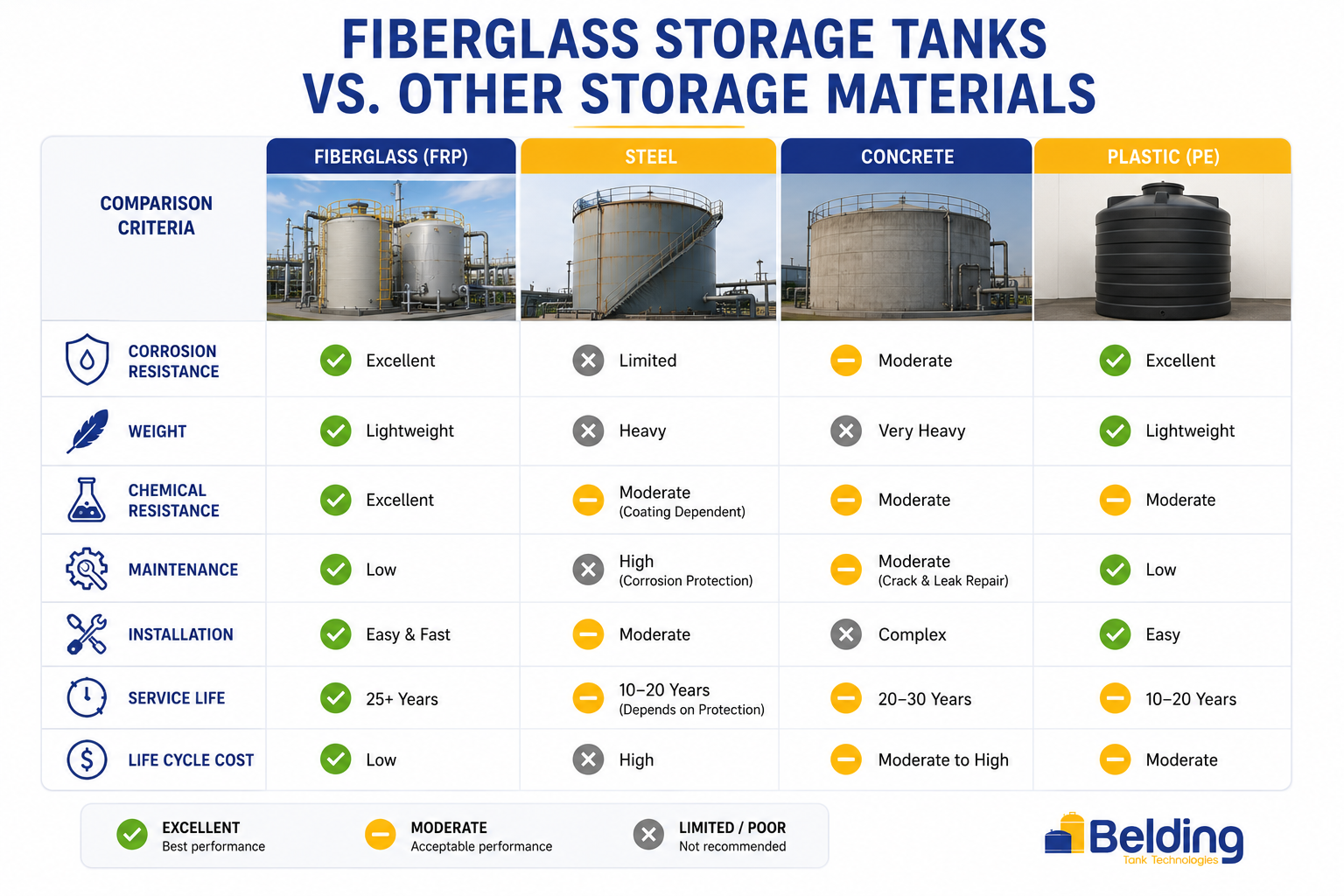
| Feature | Fiberglass Storage Tanks | Steel Tanks | Concrete Tanks | Plastic Tanks |
| Corrosion Resistance | Excellent | Moderate | Moderate | Good |
| Weight | Lightweight | Heavy | Very Heavy | Lightweight |
| Chemical Compatibility | Excellent | Moderate | Limited | Moderate |
| Structural Strength | High | High | High | Moderate |
| Maintenance | Low | High | Moderate | Low |
| Installation | Easier | Moderate | Complex | Easy |
| Service Life | Long | Moderate | Moderate | Moderate |
| Customization | Excellent | Good | Moderate | Moderate |
Fiberglass vs. Steel Tanks
Steel has been a well-established storage medium for years due to its strength and load-bearing capacity. However, when exposed to moisture, corrosive chemicals, or harsh outdoor environments, steel often requires protective coatings, routine inspections, and ongoing maintenance to prevent corrosion.
In contrast, fiberglass storage tanks are naturally resistant to rust and chemical attack, eliminating the need for extra coatings. This drastically reduces maintenance needs and prevents expensive repairs or unforeseen downtime at facilities.
Additional advantages of fiberglass include:
- Lower maintenance costs
- Better corrosion resistance
- Lightweight installation
- Improved corrosion resistance in corrosive environments
- Reduced lifecycle costs
If you’re evaluating both materials for your facility, read our blog: Why Fiberglass Is Preferred Over Metal Tanks.
Fiberglass vs. Concrete Tanks
Concrete tanks are commonly used in large-scale infrastructure and wastewater projects for their structural strength. But they are far heavier than fiberglass and may require extensive site preparation, reinforced foundations, and specialized equipment for installation.
Concrete can also crack over time, leading to increased maintenance needs and potential leakage.
Fiberglass tanks offer a few practical benefits:
- Reduced installation time
- Lower transportation costs
- Excellent corrosion resistance
- Minimal maintenance
- Easier customization
The advantages of fiberglass make it an appealing choice for industrial facilities looking for long-term efficiency.
Fiberglass vs. Plastic Tanks
For many low-demand applications, plastic tanks are lighter and cheaper to produce. But their structural flaws can be revealed in the presence of large amounts of liquid or in severe industrial environments.
FRP tanks, on the other hand, provide:
- Greater structural strength
- Better dimensional stability
- Improved chemical resistance
- Higher durability
- Longer service life
Fiberglass is more reliable in the long term for facilities that handle high storage needs or aggressive chemicals.
How to Choose the Right Fiberglass Storage Tank
Each industrial process is different and therefore requires a different kind of storage. There is more to choosing the right tank than just the correct capacity.
Working with experienced fiberglass tank manufacturers helps ensure these factors are evaluated before production begins.
- Understand the Stored Material
The chemical properties of the stored liquid determine the appropriate resin system, wall construction, and internal corrosion barrier.
Here are some questions to ask yourself:
- Is the material corrosive?
- What is the temperature range for which it is suitable for operating?
- Are the liquids going to be stored for a long time?
- Do industry standards have specific compliance needs?
- Determine Storage Capacity
The choice of capacity should consider not only production but also the business’s growth.
Tank sizing is a critical factor in a project’s cost, as oversized tanks can be extremely costly and undersized tanks can cause operational limitations.
- Consider Installation Conditions
Installation requirements vary depending on whether the tank will be:
- Above ground
- Indoors
- Outdoors
- Exposed to extreme weather
- Installed in spaces that have limited room.
These conditions affect the structural design and the choice of accessories.
- Evaluate Required Accessories
Today’s bulk storage tanks have many accessories available that can enhance their functionality, such as:
- Level indicators
- Overflow protection
- Access hatches
- Ladders
- Platforms
- Vent systems
- Monitoring equipment
- Choose an Experienced Manufacturer
Not every manufacturer can provide the same engineering opportunities. From experienced FRP tank manufacturers, you will get:
- Custom engineering
- Resin selection guidance
- Application-specific recommendations
- Quality assurance testing
- Technical support
- Long-term service expertise
Collaborating with a long-standing manufacturer minimizes project risks and helps ensure the storage solution functions as expected over its useful life.
Request a consultation to determine the most suitable fiberglass tank solution for your operating environment.
Maintenance and Inspection Best Practices
One of the primary benefits of fiberglass storage tanks is that they require comparatively little maintenance.
Regular visual inspections
Regularly check the tank for:
- Surface damage
- Cracks
- Impact marks
- UV-related wear
- Damaged fittings
- Leaks
- Fixing small problems before they get big can make a difference in the long term.
Clean the Tank as Recommended
Cleaning of stored material depends on the material and industry needs.
The cleaner the system becomes, the better the quality of the products will be and the more consistent the system’s operational performance will be.
Inspect Accessories
Regularly inspect:
- Gaskets
- Flanges
- Nozzles
- Valves
- Access covers
- Instrument connections
Often, these parts will see the most operational wear.
Follow Manufacturer Guidelines
All tanks have specified operating conditions.
By following the maintenance recommendations from fiberglass tank manufacturers, you can keep your system operating at peak efficiency and avoid voiding your manufacturer’s warranty (if applicable).
Schedule Preventive Maintenance
Instead of waiting for items to become visibly worn, facilities should establish a preventive maintenance schedule that includes regular inspections, cleaning, documentation, and periodic checks by qualified personnel.
Finally, we will discuss the importance of selecting a manufacturer that can truly make a difference and how Belding Tank Technologies Inc. can help businesses with custom-engineered FRP tanks for challenging industrial applications.
Why Work with Experienced Fiberglass Tank Manufacturers?
Choosing the appropriate storage tank is just half the investment. Equally important is selecting a manufacturing partner with an engineering background to create a solution that meets your operational needs, industry standards, and performance objectives.
The fiberglass tank industry has a long history of producing tanks, and manufacturers know that each application can present its own challenges. For instance, a storage system for chemical processing will need different resin systems, wall construction, and accessories than one used for potable water or wastewater treatment. Considering these factors at design time increases reliability and decreases future maintenance concerns.
Leading FRP tank manufacturers also provide valuable support throughout the project lifecycle, including application assessment, custom engineering, material selection, manufacturing, quality testing, and technical guidance. This method of collaboration helps ensure the tank functions properly when operated in the field.
When you assess a manufacturer, you should take into account:
- Experience serving your industry.
- Ability to design custom fiberglass storage tanks.
- Quality and Quality Control for manufacturing processes.
- Engineering and technical assistance.
- Material selection expertise.
- Adherence to relevant industry standards.
- A long-term commitment to customer service.
Choosing a manufacturer with proven experience can help reduce project risks while maximizing the return on your investment.
Why Choose Belding Tank Technologies Inc.?
Industrial facilities need storage solutions that are dependable year after year. Belding Tank Technologies Inc.’s philosophy is to manufacture engineered FRP storage systems tailored to customer operating conditions.
Rather than offering one-size-fits-all products, Belding designs and manufactures custom FRP tanks, bulk storage tanks, and fiberglass water tanks tailored to each application’s operating conditions. The company has a long history of providing products for the chemical processing, pharmaceutical, wastewater treatment, agriculture, aquaculture, and food processing industries, all of which rely on long-lasting, corrosion-resistant storage solutions.
Belding Tank Technologies Inc. collaborates with customers to gain insight into factors such as stored media, environment, installation, and long-term operational goals. By working together, these steps ensure that each storage solution will be built to deliver reliable performance, efficient installation, and long-term value.
From a standard configuration to a fully customized storage system, working with an experienced manufacturer can help you make your investment last for years to come.
Build a Storage Solution That Performs for Years to Come
Selecting the right storage system is an investment in the efficiency, safety, and long-term performance of your operation. Whether you’re storing chemicals, water, wastewater,
agricultural products, or process fluids, selecting the appropriate material and manufacturing partner can significantly reduce maintenance costs while improving operational reliability.
At Belding Tank Technologies Inc., we combine engineering expertise with decades of manufacturing experience to deliver custom fiberglass, FRP, and bulk storage tanks built to meet the demands of challenging industrial environments.
Whether you’re installing a new storage system or replacing an existing one, our staff is here to help you select the right product for your application. Discuss your project requirements, get expert guidance, or receive a custom quote that suits your operation’s needs with Belding Tank Technologies Inc. today.
Frequently Asked Questions
How does a fiberglass tank differ from FRP tanks?
The terms are often used synonymously. FRP tanks are produced using composite technology with fiberglass-reinforced resin. In most industrial applications, the terms "fiberglass tanks" and "FRP tanks" refer to the same type of storage solution.
How to select the right fiberglass tank manufacturer?
Look for manufacturers with proven engineering expertise and a strong understanding of your specific storage requirements. Working with experienced fiberglass tank manufacturers helps ensure the storage system is designed for long-term reliability.
Do fiberglass storage tanks require regular maintenance?
While fiberglass storage tanks generally require less maintenance than many traditional materials, routine inspections, cleaning, and preventive maintenance remain important for maximizing service life and ensuring reliable operation.


